
What are Cleanroom Classifications?

A cleanroom environment can be required in a variety of manufacturing, scientific, and medical environments. For instance, in the aerospace industry, there are certain manufacturers that make very intricate parts for airplanes. These parts may be used in the engine, flight controls, hydraulics, and other critical systems. However, since these systems are relied upon to keep a giant piece of metal in the sky, the parts that make up these systems have to be absolutely perfect.
Therefore, they use a highly controlled environment to manufacture these parts. Cleanrooms offer a solution to this problem by controlling the size and number of particles that are present in the work environment.
Similarly, pharmaceutical companies require a highly controlled environment when manufacturing and packaging medicine. Medical device manufacturers, electronics companies, and scientific research facilities often have similar requirements. In order to help determine how "controlled" a cleanroom environment is or needs to be, the International Organization for Standardization (ISO) developed a system of cleanroom classifications.
Cleanroom Classification Basics
Ultimately, it is not too hard to conceptualize ISO cleanroom classifications and how they are organized. The gist of it is that a cleanroom is allowed a certain number of airborne particles within a given volume of air. The fewer the particles in that space, the cleaner the environment. These particles can include dust, microbes, aerosols, and other contaminants that could interfere with a manufacturing process, scientific experiment, or product.
The lower the ISO class number, the fewer particles permitted in the environment and the lower the risk of contamination.
ISO cleanroom classifications range from ISO 1 to ISO 9, with ISO 1 being the cleanest and ISO 9 being the least stringent. These classifications are organized on a logarithmic scale, meaning each increase in class allows significantly more particles in the air. For example, ISO 1 is the most strictly controlled cleanroom environment available. In an ISO 1 cleanroom, there can be no more than 10 particles measuring 0.1 micrometers or larger in a cubic meter of air. For the next level, ISO 2, there can be no more than 100 particles of the same size in a cubic meter, and so on.
While many people still refer to cleanrooms using the older Federal Standard 209E terminology, such as Class 100 or Class 10,000, ISO 14644-1 is now the internationally recognized standard used to classify cleanroom environments.


How Are Cleanroom Classifications Maintained?
Achieving a cleanroom classification requires more than simply enclosing a space. Cleanrooms rely on carefully controlled airflow, filtration, pressure relationships, and operating procedures to maintain cleanliness levels.
Most cleanrooms use HEPA or ULPA filtration systems to remove airborne particles before air enters the workspace. Positive pressure environments are commonly used to prevent contaminants from entering the room when doors are opened. Additional spaces such as gowning rooms, airlocks, and anterooms help reduce the amount of contamination introduced by personnel and materials.
In many facilities, environmental monitoring systems are also used to track particle counts, pressure differentials, temperature, and humidity to ensure the cleanroom continues to operate within its required classification.
How Clean Is It?
To better understand the variance from level to level, let's walk through a few examples of where different cleanroom classifications are commonly used.
ISO 8 Cleanroom / Class 100,000
This level of cleanroom offers a lower level of contamination protection but still represents a significant improvement over standard room air. ISO 8 cleanrooms are commonly used for packaging operations, medical device manufacturing, and certain pharmaceutical processes.
For example, Panel Built recently provided a 2,496-square-foot ISO 8 cleanroom for IMI Charlotte. The project combined a controlled production environment below with a structural mezzanine above, allowing the customer to maintain cleanliness requirements while maximizing available floor space.
ISO 7 Cleanroom / Class 10,000
This level of cleanroom can often be found in medical, pharmaceutical, and electronics applications. The handling of sensitive materials frequently requires special equipment and a controlled environment to reduce the risk of contamination.
One example is a 1,440-square-foot Class 10,000 cleanroom system built for an electronics manufacturer. The facility included a dedicated gowning room and two Class 10,000 cleanroom areas, all maintained under positive pressure to help keep contaminants out of the testing environment.
ISO 6 Cleanroom / Class 1,000
ISO 6 cleanrooms begin to reach the levels of contamination control often required in scientific research and advanced manufacturing environments.
When operating inside a cleanroom with these contamination standards, occupants are typically required to wear specialized garments designed to prevent particles from being released from the body into the environment. Even a small amount of contamination could impact sensitive testing or research results.
ISO 5 Cleanroom / Class 100 (and Higher)
ISO 5 cleanrooms and cleaner environments are typically utilized in high-precision manufacturing, life sciences, pharmaceutical production, and advanced electronics manufacturing.
These environments often require workers to pass through a gowning room before entering the cleanroom. Strict cleaning protocols, filtration systems, and operational procedures are used to maintain the required classification level and minimize the risk of contamination.

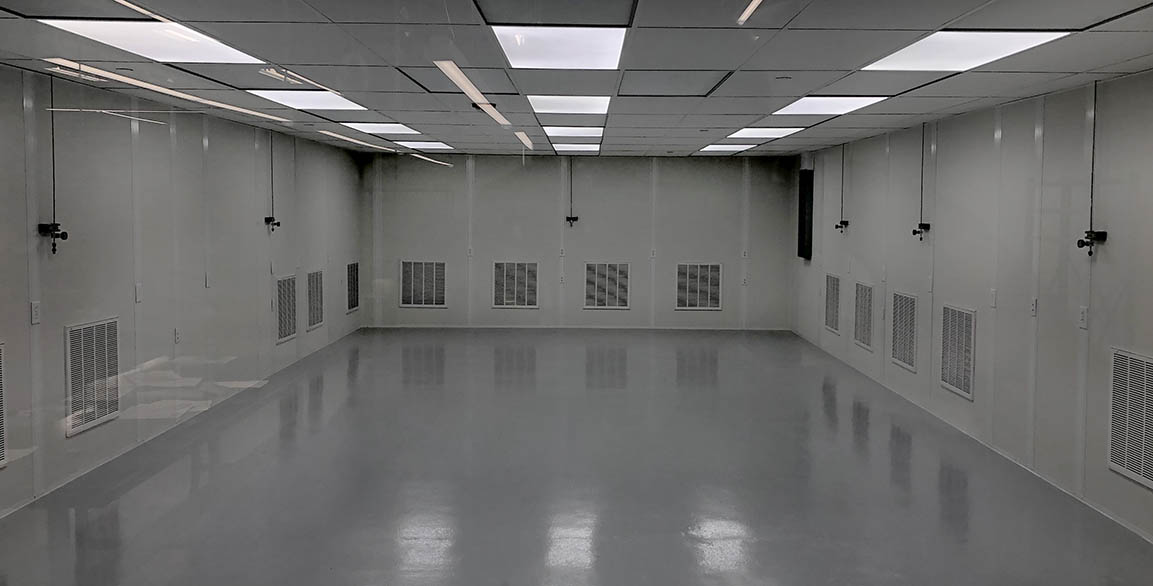
In the video below, Austin from Panel Built explains the fundamentals of cleanroom design and shares insights from a Class 10,000 cleanroom installation.
Choosing the Right Cleanroom Classification
The appropriate cleanroom classification depends entirely on the application. Pharmaceutical manufacturing may require different cleanliness standards than electronics testing, aerospace manufacturing, or medical device assembly.
When evaluating a cleanroom project, it is important to consider not only the required ISO classification, but also airflow design, filtration requirements, personnel flow, material handling procedures, and future expansion plans.
At Panel Built, we design modular cleanrooms for a variety of industries, including pharmaceutical manufacturing, electronics production, medical devices, and research applications. Cleanroom systems can be configured with HEPA or ULPA filtration, positive pressure environments, gowning rooms, airlocks, and custom layouts designed around the specific process being performed.
If you have questions about a cleanroom project or would like a cleanroom quote, give us a call at 800-636-3873, email us at [email protected], or request a free quote.